- Science Says
- Posts
- Use stars ★ not numbers for ratings
Use stars ★ not numbers for ratings
Showing product ratings in stars ★★★★☆ (vs numbers like 4/5). Ratings seem higher, and people were up to 64% more likely to choose a product.

Thomas McKinlay
May 20, 2025
Topics: Reviews | Ecommerce | Website/App
For: B2C. Can be tested for B2B
Research date: March 2024
Universities: University of Tennessee, University of South Florida
📝 Intro
You’ve probably wondered what is the most effective way to show your product ratings - whether on your website, ads, or even packaging and social media.
Should you go for:
Symbols (e.g. ★★★☆☆)
Numbers (e.g. 3/5)
New research gives us the answer, and why.
P.S.: Very high ratings (between 4.5 and 5) can make people skeptical and lead to fewer sales than ratings between 4 and 4.5
📈 Recommendation
Show your product rating using stars, circles, bars or another visual form, instead of using numbers. Avoid using number ratings (e.g. 3.5 / 5) because people might consider the rating number to be lower.
On average, people will consider your rating to be higher, be more likely to choose the product and will have higher purchase intentions.

🎓 Findings
When a product’s rating is given as a visual element (e.g. stars or bars) instead of as a number, people consider the rating higher and are more likely to choose the product and say they’d buy it.
As part of a series of 9 experiments, including an eye-tracking study and an analysis of Google ads, researchers found that:
A travel-sized toothpaste with a 3.7 rating was judged 25.7% higher when it was shown in stars, instead of numbers, making people choose it 64% more often
A 3.5 rating for a portable charger was considered 23.9% higher when it was shown in stars as compared to a number
People were 10% more likely to say they would buy a portable speaker with a 3.8 rating when the rating was shown in stars, instead of as a number.
When A/B testing on Google Ads, ads using a star format for ratings had a 52.6% higher CTR than those using numerical ratings.
The effect:
Disappears when the rating decimal is closer to the full number on the left digit (e.g. 3.1, 3.2, 3.3, 3.4)
Reverses when the rating scale sets 1 as the best and 5 as the worst). In this case, showing the rating as a number increased purchase intentions by 24.3%.
🧠 Why it works
We tend to think number ratings with decimal points (e.g. 2.5 or 3.75) are smaller than they actually are.
When we look at numbers, we mainly look at the leftmost digit to understand how far apart two numbers are. For example, we consider the price difference between $2.99 and $4 as larger than the difference between $3.00 and $4.01. This is called the left-digit bias.
Because of this, when we see a number at or higher than the midpoint of a rating (e.g. ending in .5 or higher), we round it down in our head. For example, we’d view 3.7 as 3.
This doesn’t affect the accuracy of how we perceive ratings that are below the midpoint of a rating (e.g. ending in less than .5) as those round downwards when brought to the nearest integer anyway.
When visual elements, like stars, are used instead of numbers, there is no left digit to focus our attention, so our perception of the number is more accurate.
The higher we think something is rated, the more likely we are to choose the product, because we assume a higher rating means better quality.
✋ Limitations
The research looked mostly at mid to high ratings on a five point scale (e.g. 3.5 out of 5). It’s likely that the effect holds for more precise numbers (3.54) or ratings on different scales (e.g. 3 point scale, 10 point scale).
It’s also unknown if the effect holds the same way for very low (e.g. 1.5/5) or very high (e.g. 4.8/5) ratings.
Though it wasn’t looked at in-depth, the study did find that rectangular bars (compared to stars circles or numbers) make a rating seem even larger. Further research would be required to understand why this is true and what shapes or types of shapes it holds for.
It’s likely, but wasn’t studied, that people respond to various types of ratings differently depending on the platform (e.g. an ecommerce app, a company website or in search results), as well as at different stages of the buying journey.
🏢 Companies using this
Websites often change their rating format between their homepage and when a customer selects an individual product. For example Amazon uses a number rating on their main screen, a combination of numbers and visuals on product landing pages and a visual rating when sharing other similar items.
Uber Eats, TripAdvisor and Facebook all currently use numbers to display ratings across their platforms.
In contrast, Google Maps uses both numbers and visuals next to one another.
Review site Yelp uses visuals only for their ratings.
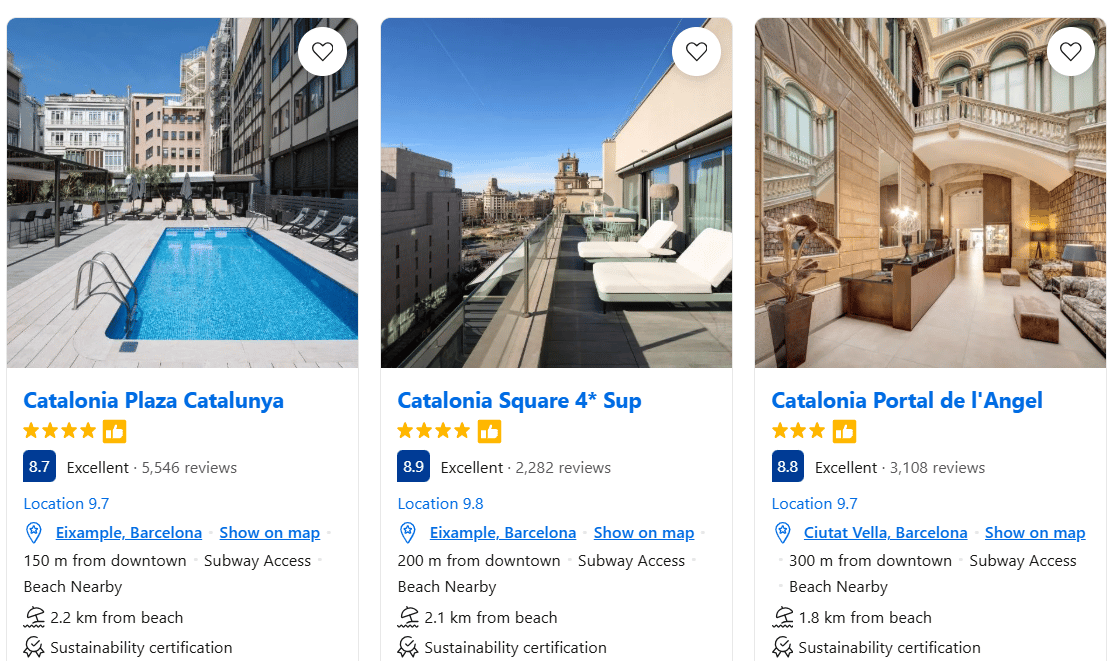
Booking.com’s review ratings are shown in numbers on a 10 point scale - these ratings are likely to be rounded down by viewers to 8, despite being closer to 9.
⚡ Steps to implement
Showcase your product ratings and customer reviews, using visuals (e.g. stars, bars or circles) instead of numbers.
If you’re selling on ecommerce platforms that display their ratings as numbers, add your average ratings in a visual form (e.g. with stars) as part of your product visual or description on your product page and keep it updated.
Other research highlights that people value honesty in ratings and appreciate negative reviews as long as the overall rating is still good (4 to 4.5 stars).
When people visit your product page to see user ratings, try to show a first review that’s positive and provides useful information (e.g. additional details about the product, who the product is ideal for).
If you’re operating in a country where ratings are usually arranged on a “smaller is better” scale, where 1 stands for excellence, display ratings as numbers instead of symbols.
🔍 Study type
Lab and online experiments and field experiments (Google Ads campaign for a clothing retailer in Tennessee with 39,272 impressions)
📖 Research
The Power of a Star Rating: Differential Effects of Customer Rating Formats on Magnitude Perceptions and Consumer Reactions. Journal of Marketing Research (March 2024)

🏫 Researchers
Annika Abell. University of Tennessee
Carter Morgan. University of South Florida
Marisabel Romero. University of Tennessee
Remember This is a new scientific discovery. In the future it will probably be better understood and could even be proven wrong (that’s how science works). It may also not be generalizable to your situation. If it’s a risky change, always test it on a small scale before rolling it out widely.
Subscribe to the Science Says Platform to read the rest.
Become a paying Platform member of Science Says to access this page.
Subscribe to PlatformWhat you get as a Platform member:
- Access all insights: Hundreds of insights (and growing)
- Case studies: Get science-based answers to marketing challenges
- Exclusive playbooks and discounts on all playbooks