- Science Says
- Posts
- ‘AI-designed’ hurts sales
‘AI-designed’ hurts sales
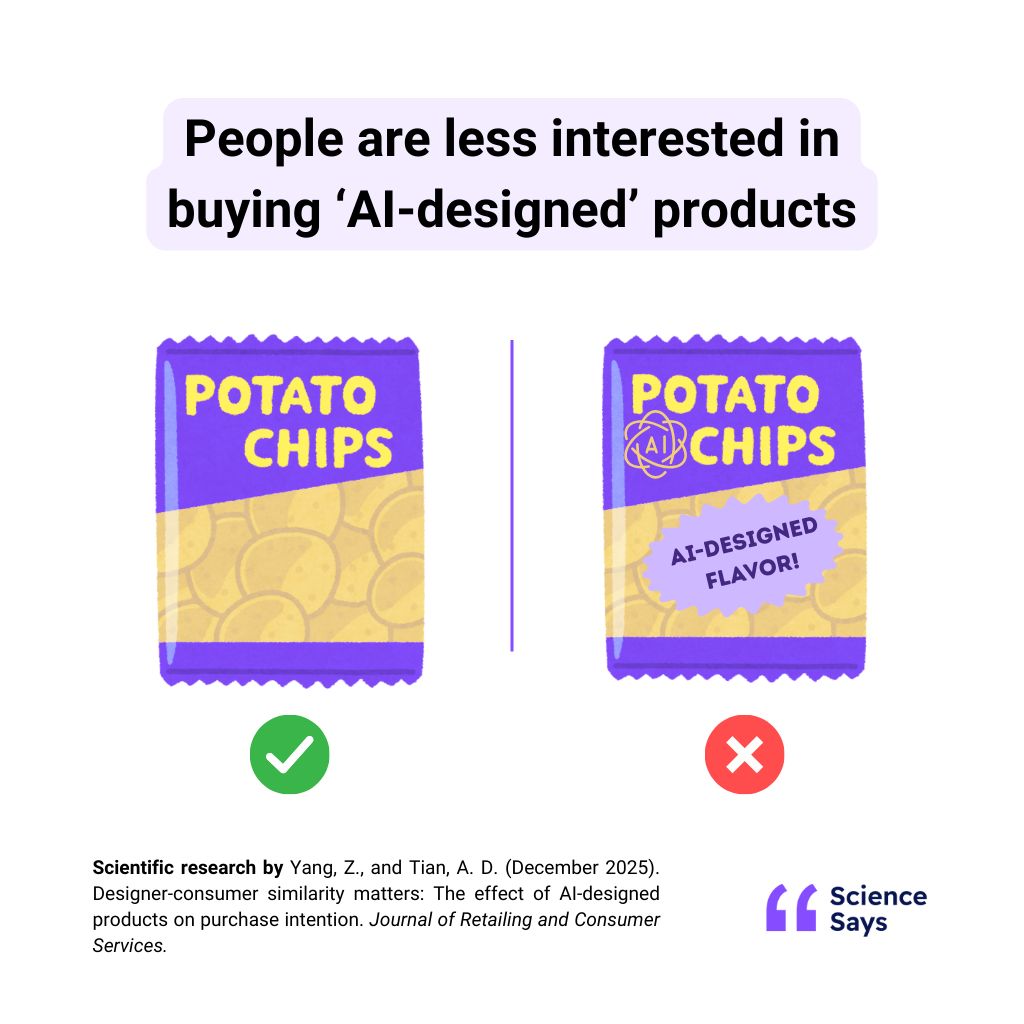
People are up to 29% less willing to buy products designed by AI (e.g. a chair, a snack flavor), compared to those designed by humans.

Thomas McKinlay
March 17, 2026
📝 Context
Topic: Product, AI
For: B2C. Can be tested for B2B
Research date: December 2025
Universities: Shanghai University of Finance and Economics, Shantou University
You’re the CEO of a small perfume brand and are trying to find new fragrances to make your company more competitive. You recently found out that Tom Ford used AI to generate a new fragrance combination and have decided to try the same. The results are great, the new collection is fresh, innovative, and intriguing.
Considering the press coverage of Tom Ford’s AI-generated fragrance, you decide to jump on the bandwagon and call it “AI-created delight”.
“That’s going to sell so well!” you think, but on launch day, not even your most loyal customers buy it.
Here’s why.
P.S.: If you use AI, be careful how you communicate it. People have mixed feelings about it. They are ok with using it themselves, but when others use it they are more likely to judge them negatively.
📈 Recommendation
If you are using AI to design your products, be strategic about how you communicate it:
If AI is used in collaboration with human designers, clearly state that human designers are involved in the design process (e.g. “Our designer Alex used AI to develop this feature”).
If your product is fully designed by AI (e.g. AI developed the style, the colors, shapes etc.), avoid labeling it as “AI designed”.
People will be more interested in buying.
🎓 Findings
People are less likely to buy products designed by AI compared to those designed by humans.
Across 9 experiments on physical products (e.g. perfumes, potato sticks), researchers found that when products were labeled as “AI-designed” (vs human designed), people:
Had up to 28.8% lower purchase intentions
Thought there was 75.1% less human involvement in the design process
When the product was described as designed through human-AI collaboration (e.g. a human used AI to brainstorm color combinations), purchase intention was 3.5% higher than human-designed products, and 12.8% higher than AI-only designs
The effect is:
Stronger among people who closely tie their identity to the product (e.g. Bikers with Harleys)
Reversed when the product is rented (vs. purchased). People were 14% more willing to rent AI-designed products (e.g. camping gear) than human-designed ones.
🧠 Why it works
We find products, brands and people more appealing if we feel they align with our identity (e.g. a sustainable product if we are eco-conscious).
So we are more willing to buy products from people we think are similar to us (e.g. we are dog lovers and think a grooming tool designer probably is too).
When products are fully designed by AI, we cannot identify with the designer, making us less likely to buy the product.
However, if we know a human worked with the AI, we can still feel aligned with the designer, and be more willing to purchase.
When we rent a product (e.g. camping gear) instead of buying, we care less about the identity but more about the utility. Therefore, the similarity of the designer is less important, and we are willing to buy fully AI-designed products.
✋ Limitations
People in this research were told when products were AI-designed. It’s unclear how the effect might change when people are left wondering, or when they know a product is AI, but aren’t told explicitly.
Only physical products were analyzed (e.g. camping chairs, snacks), the effect might differ for other kinds of products with very specific purposes such as those requiring technicality and precision (construction tools), creativity (e.g. artworks), or with high stakes (e.g. medicines).
It’s also unclear how the effect applies to digital products, or in B2B scenarios where AI expertise is expected or valued (e.g. a data analysis tool).
👀 Real-life example
Interior design brand Kartell paired up with designer Philippe Starck to bring to life the first-ever AI-designed chair.

❌ Issue: Their product is the result of human-AI collaboration, and they state so in the product description. However, they might be risking turning customers away with their current positioning.
✅ Solution: There are a few things they could try to fix this:
Firstly, clearly frame human-AI collaboration as added value (e.g. “the designer set the vision, and AI was used to achieve maximum technical precision for extra comfort”).
Reframe how AI was used, as it could make the designer’s input less valuable. For example, they could frame the AI as a technical aid (not a tool doing the designer’s job) and say “Philippe used an AI trained specifically to finalise the technical details more precisely, but the creative direction is entirely his”.
Prevent objections by using social proof, showing the number of likes or purchases on the website. This would also make people more likely to buy.
🔍 Study type
Online experiments (participants from both China and the U.S.).
📖 Research
Designer-consumer similarity matters: The effect of AI-designed products on purchase intention. Journal of Retailing and Consumer Services (December 2025)
🏫 Researchers
Zhen Yang, Shanghai University of Finance and Economics
Allen Ding Tian, Shantou University
Remember: This is a new scientific discovery. In the future it will probably be better understood and could even be proven wrong (that’s how science works). It may also not be generalizable to your situation. If it’s a risky change, always test it on a small scale before rolling it out widely.
🎁 Bonus: Trivia
Check your knowledge from previous insights (for paid Platform members only).
❓ Guess the effect:Who’s most likely to use AI? |
Subscribe to the Science Says Platform to read the rest.
Become a paying Platform member of Science Says to access this page.
Subscribe to PlatformWhat you get as a Platform member:
- Access all insights: Hundreds of insights (and growing)
- Case studies: Get science-based answers to marketing challenges
- Exclusive playbooks and discounts on all playbooks